
The complete guide
H1 LED Headlight Bulbs, A Straightforward Buyer's Guide
The problem this set solves
Most people who go looking for H1 LED headlight bulbs are doing it for one of two reasons. Either they are building something, a project car, a show vehicle, a green lane rig, and they want the lamps to look clean and consistent, or they have a lamp that currently runs a yellow-tinted halogen bulb and the colour does not match everything else on the build.
Halogen bulbs have a warm, slightly yellow cast. LED bulbs at 6000K read as cool white. Side by side, the difference is obvious. If half your lighting has already been changed and half has not, the mismatch is the thing that bothers you every time you walk around the vehicle.
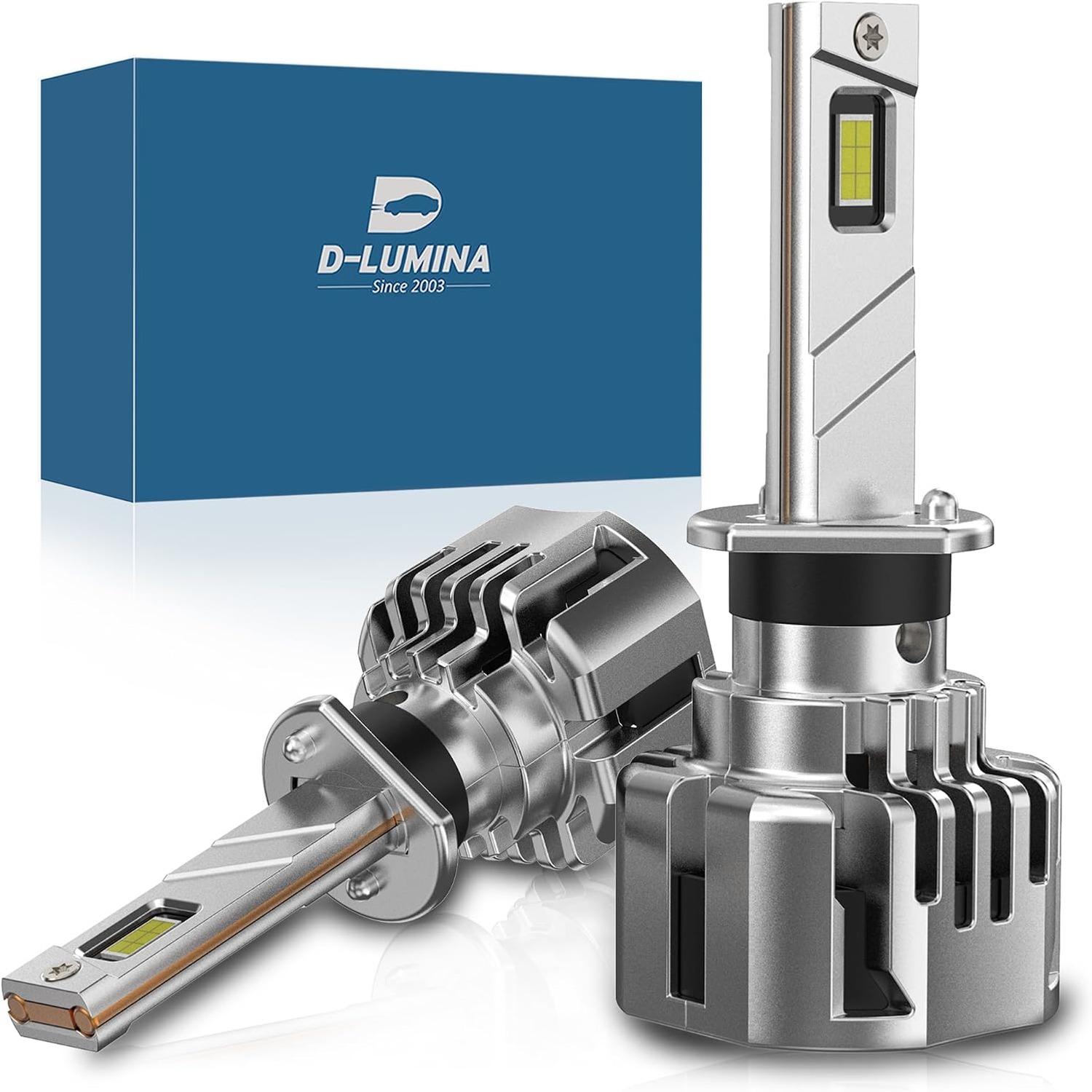
This pack is two H1 LED bulbs with a 6000K colour temperature, a cooling fan built into each body, and an IP60 rating against dust. That is what you get, and the rest of this guide is about deciding whether it is the right thing for you.
Read the restriction first
Before anything else, be clear about where these can be used. This is an LED conversion bulb. In Ireland, fitting LED bulbs into headlights that were designed for halogen bulbs is generally not permitted on public roads.
So this set is sold for off-road, show and private property use. That covers quite a lot, actually. Track days, off-road courses, static displays and concours, farm and yard vehicles, workshop rigs, lamps on trailers and equipment that never see a public road. If that describes your use, you are in the right place. If you need a bulb for daily driving on public roads in a halogen headlamp, this is not the product for you, and we would rather say so now than after you have paid for it.
What H1 actually is
H1 is a bulb base standard. Physically it is a single-contact fitting with a flat metal locating tab and a short wire tail coming off the back. It is one of the older and more common single-filament fittings, and it shows up all over the place, in main beam units on cars that use a four-lamp layout, in some dipped beam units, in fog lamps and in plenty of aftermarket auxiliary driving lamps.
The easiest way to confirm what you have is to pull the existing bulb and read the code printed on the metal base or glass. It will say H1 if that is what you have got. Do not guess from a parts website alone, because trim levels and facelifts change lamp units more often than people expect.
Fitment here is by fitting type only. If the lamp takes an H1 bulb, the base on these matches. We do not claim fitment to any named vehicle.
Why there is a fan in the bulb
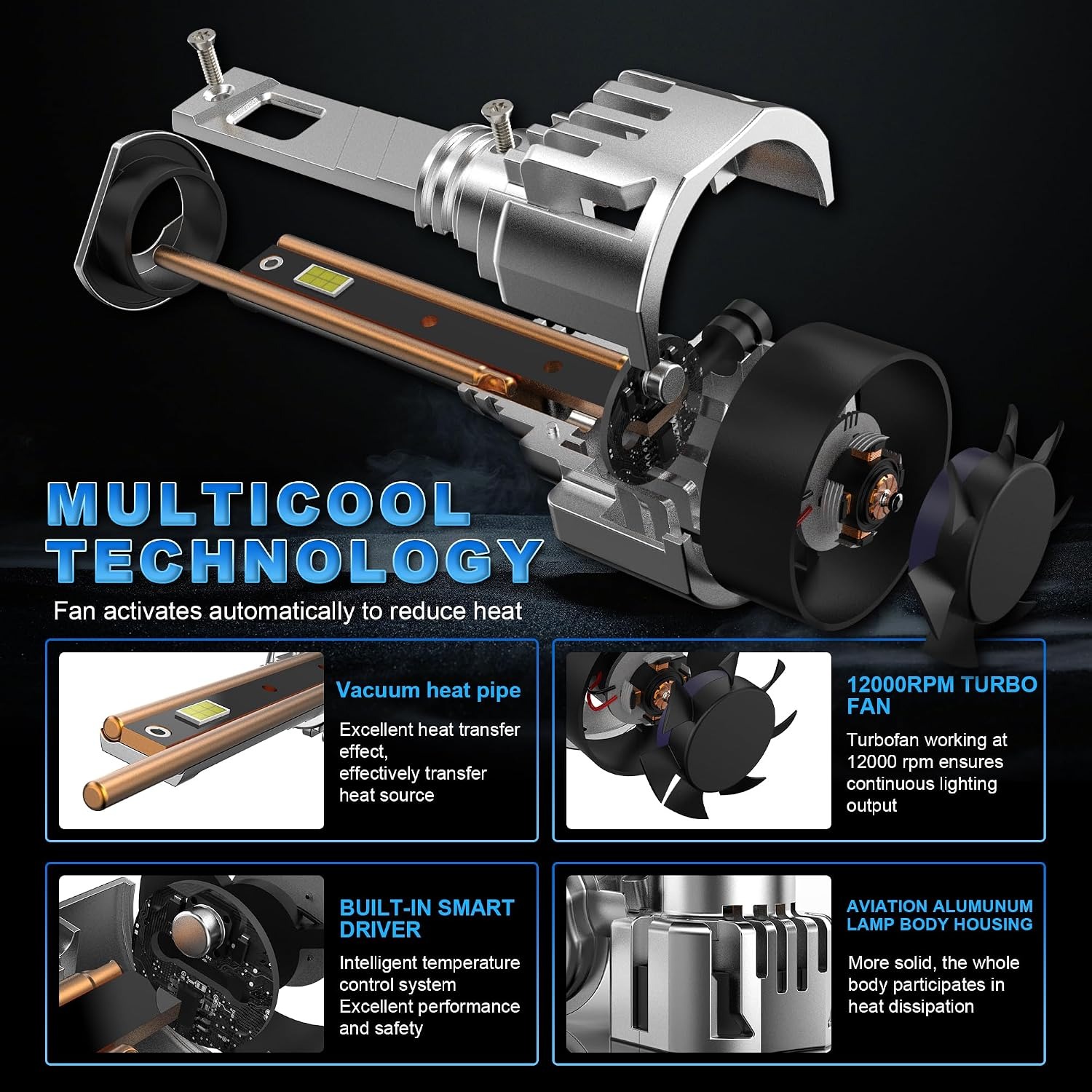
A halogen bulb throws most of its heat out of the front as infrared. An LED does the opposite. It throws light forwards and dumps heat backwards into the base, and that heat has to be carried away or the LED output suffers.
That is why each of these bulbs has a cooling fan built into the body. Air gets pulled through while the bulb is powered. Two practical things follow from this.
The first is clearance. A fan-cooled LED bulb sits further out of the back of the lamp than a halogen bulb does. Before you order, pop the dust cap off and look at how much room there is between the rear of the bulb holder and whatever sits behind it, be that a strut tower, a battery, an air box or a wiring loom. If it is very tight, the dust cap may not go back on properly, and you will be looking at a different solution.
The second is air flow. A fan that is packed against insulation or buried under a sealed cover cannot do its job. Leave it room to breathe and keep the opening clear of dust and road grit.
Understanding 6000K
Colour temperature is measured in Kelvin and it describes tone, nothing else. Lower numbers run warm and yellow. Higher numbers run cool and blue. Around 6000K you land on a clean, neutral white that most people describe as looking like daylight.
A common mistake is to read a higher Kelvin number as meaning a better bulb. It does not. It is purely a description of what the light looks like. Choose it because of how you want the build to look and because of what matches the rest of your lighting.
The one genuinely useful thing about knowing the Kelvin figure is matching. If your auxiliary lamps are already in the 6000K range, a 6000K H1 bulb will sit comfortably alongside them. If everything else on the vehicle is warm halogen, a single LED pair will stand out.
The electrical side
LED bulbs draw current in a different way from halogen bulbs. Some vehicles watch bulb circuits for faults, and when the current drops the system can read that as a failed bulb. The symptoms are easy to spot. You get a bulb warning on the dash, or the lamp flickers, usually at idle or just after start-up.
The fix for this is a CANbus decoder, which sits inline and keeps the circuit looking normal to the vehicle. A decoder is not included with this set. If you know your vehicle is sensitive to bulb changes, factor that in as a separate purchase. If you are not sure, fit the bulbs first and see what happens, because plenty of setups work without one.
That is the honest position. It is a compatibility issue, not a fault, and it affects some vehicles and not others.
Fitting them without drama
Switch the ignition off and let the existing bulbs cool before you touch anything. Halogen bulbs run hot enough to burn.
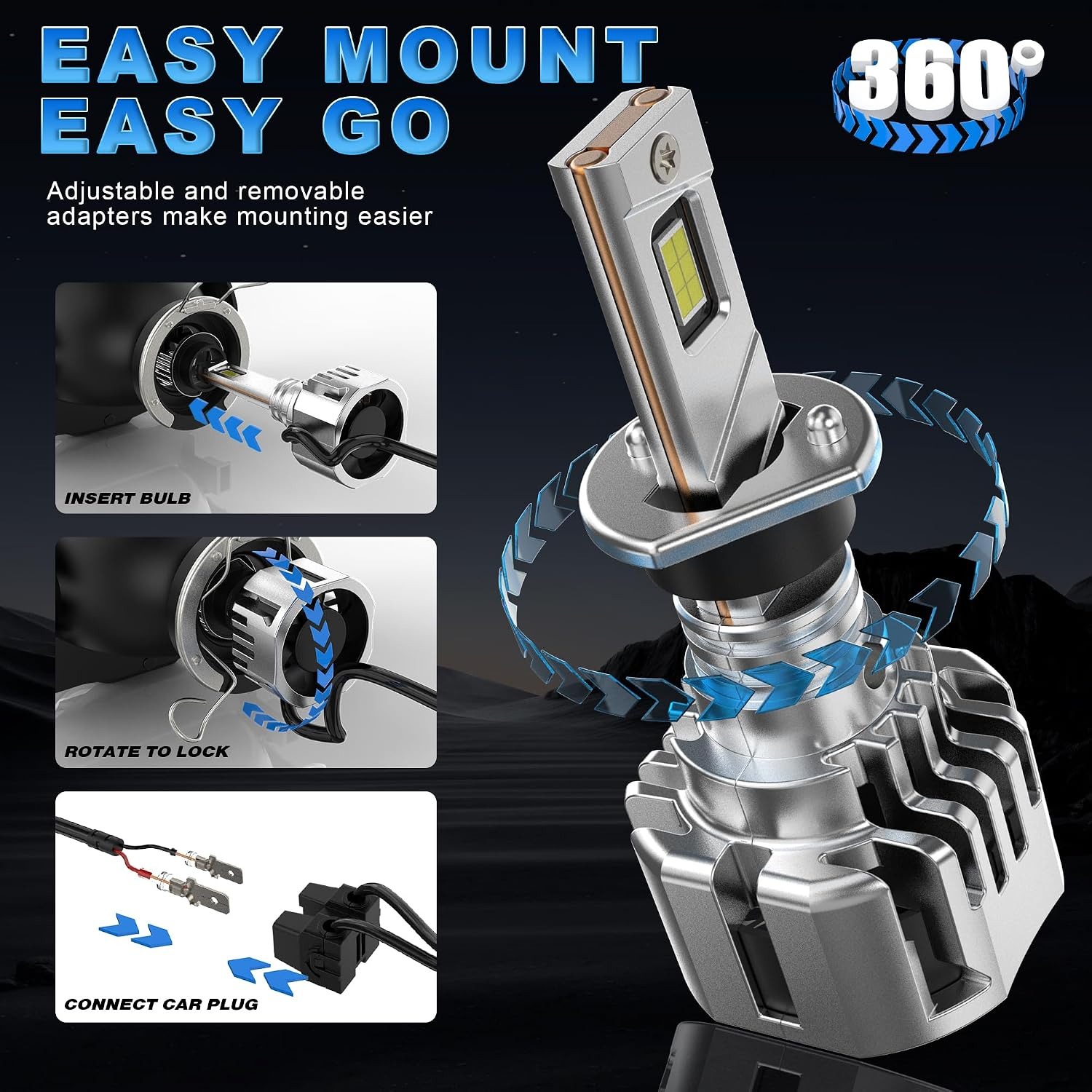
Get the lamp open, whether that means a dust cap, a cover panel or lifting the whole unit out. Release the retaining clip, unplug the old bulb and set it aside. Handle the new LED bulb by the metal base only. Fingerprints on the chips or the lens collect dust and are a nuisance to clean off later.
Seat the new bulb so the locating tab drops into its slot. It should sit flat and square, not cocked at an angle. Clip it in, reconnect, and test before you close everything up. Do the second side the same way.
Then refit the dust cap properly. A cap that does not seal lets moisture into the housing, and moisture in a headlamp is a slow, annoying problem.
Looking after them
There is not much to it. Keep the fan opening clear so air can move. Wipe the body with a dry or barely damp cloth if it needs it, and keep water away from the connector. Do not submerge the bulb.
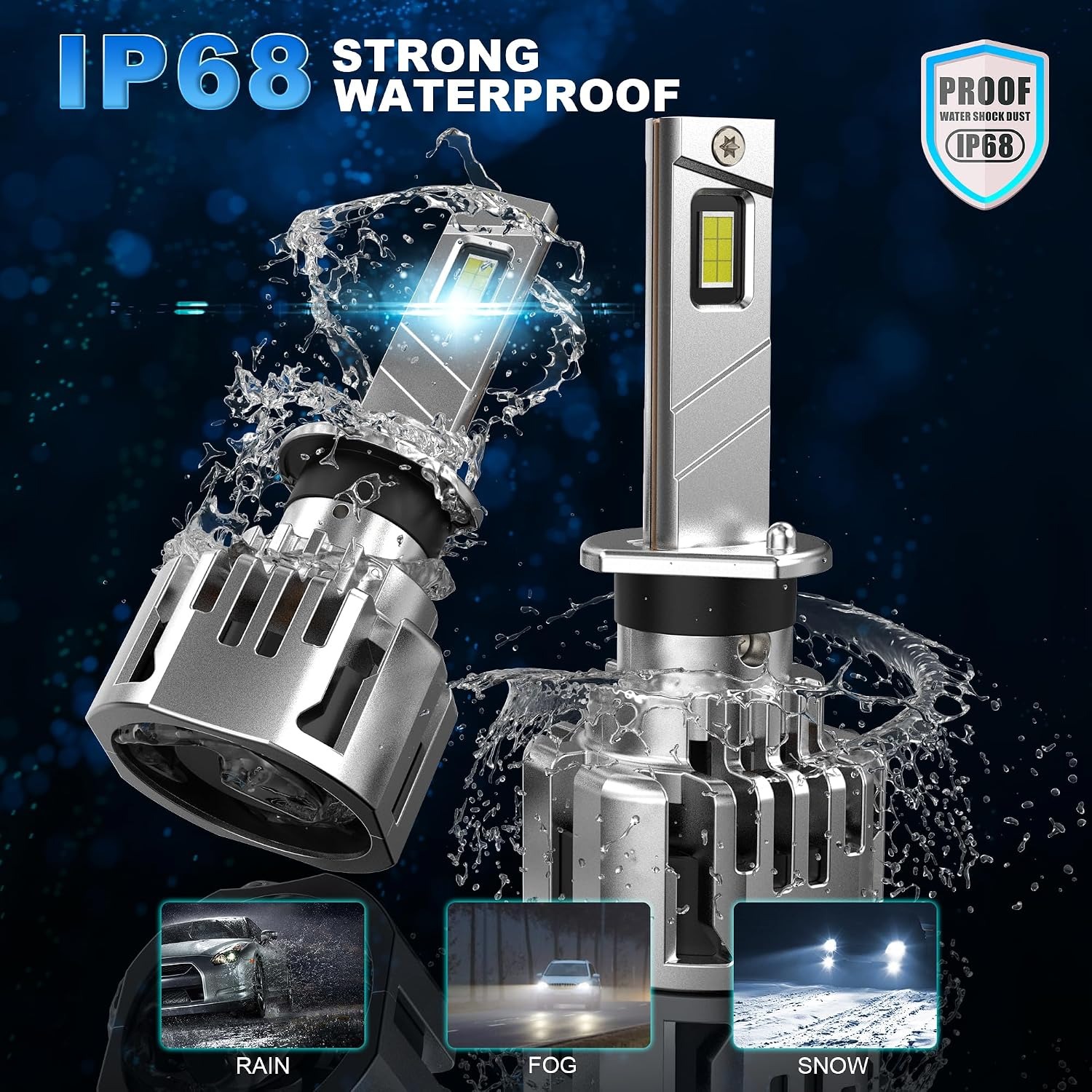
The IP60 rating means dust protection is covered, with no specific water jet rating assigned. In practice that means these belong inside a lamp housing that seals properly, not out in the open.
If output ever looks uneven between the two sides, swap them left to right. If the problem moves with the bulb, you know where the issue is. If it stays with the lamp, look at the wiring or the connector instead.
Who this suits
Project builders who already run H1 lamps and want matching white output. Show car owners who need the vehicle to look right under display lighting. Off-road and green lane users running auxiliary lamps. Anyone with farm, yard or site vehicles on private ground that take an H1 bulb.
Who it does not suit is anyone needing a bulb for a halogen headlamp on a public road in Ireland. That is not what this is for.
The short version
Two H1 LED bulbs, 6000K colour, a fan in each body, IP60 rated against dust. Sold as a pair so both sides match. Some vehicles will need a CANbus decoder to stop a warning light or flicker, and one is not included here.
Check three things before you buy. That your lamp really does take an H1 bulb, that there is room behind it for a fan-cooled body, and that your use is off-road, show or private property. Tick all three and this is a simple, tidy swap.