
The complete guide
H4 LED Headlight Bulbs, A Straight-Talking Buyer's Guide
The problem these bulbs are meant to solve
If you have ever opened the bonnet on an older vehicle, pulled the dust cap off a headlight and found a yellowish bulb that has clearly seen better days, you already know why people start looking at LED swaps. Halogen bulbs dim slowly over time. The change is gradual enough that you often do not notice until you fit a fresh one and realise how much the old pair had faded.
Then there is the look. A 6500K LED reads as a cool white. Next to a tired halogen it is a completely different tone, and for a show car, a project build or an off-road rig, that tone is a big part of why people make the change in the first place.
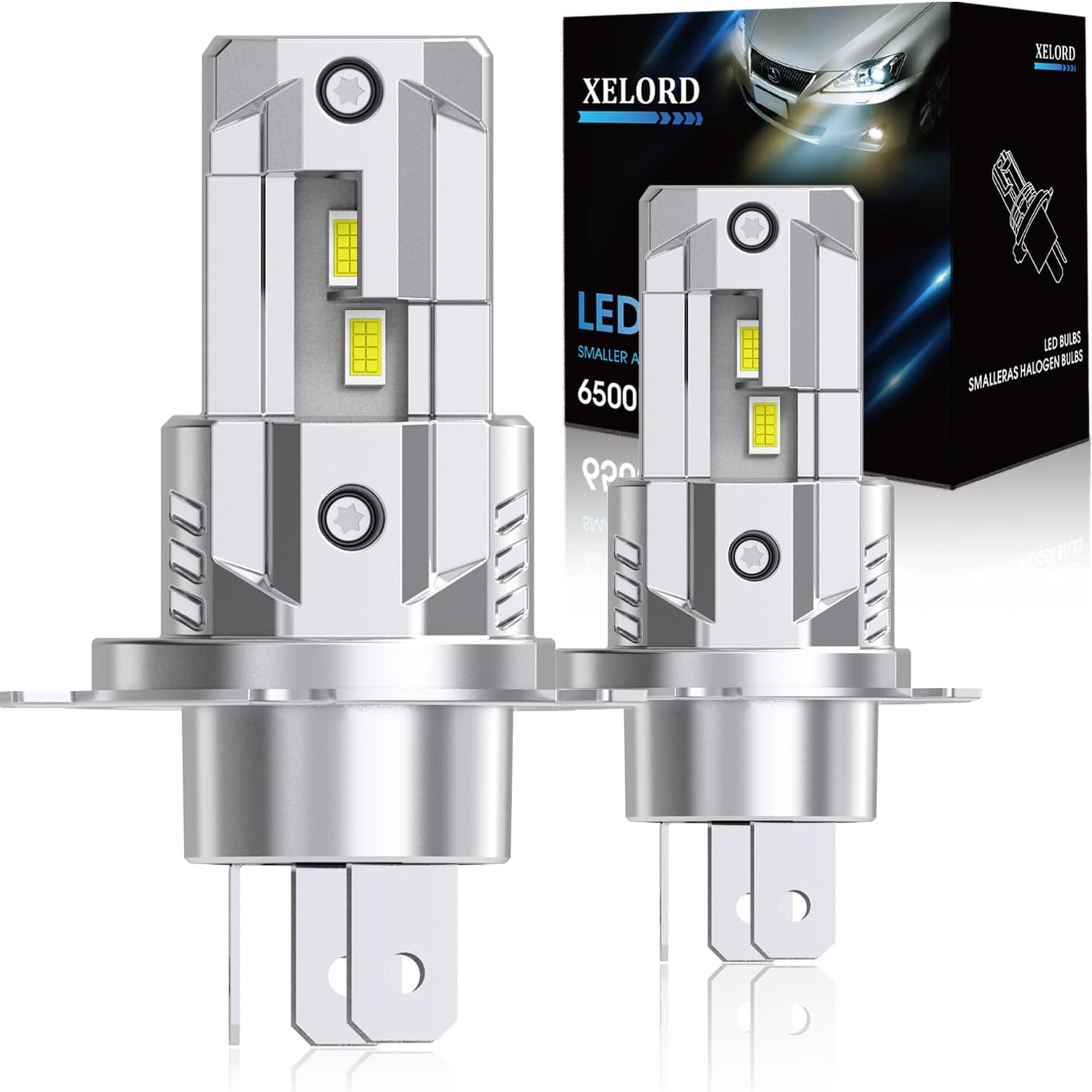
So this set exists for a specific job. It is a pair of H4 LED bulbs for a vehicle or machine that uses the H4 fitting, runs 12 volts, and is used off the public road.
Say the legal part first
Let us not bury this in the small print. In Ireland, fitting LED bulbs into headlight units that were built for halogen bulbs is generally not permitted on public roads. These are LED conversion bulbs. They are sold here for off-road, show and private property use.
That is not a technicality we are brushing past. If the vehicle in question is your daily driver and it goes on public roads, this is the wrong part and you should not buy it. If it is a field vehicle, a quad, a trailer rig, a track or show car, a machine that lives on private land, or a project that is not registered for road use, then read on.
We would rather lose a sale than have you fit something you cannot legally use. Plenty of sellers are vague about this. We are not going to be.
What H4 actually means
H4 is a bulb base code. It describes the shape of the base, the position of the contacts and the twin-function arrangement where one bulb covers both the dip and main beam positions. It is one of the most common fittings there is, which is exactly why so many people search for the best h4 led headlight bulbs rather than something more obscure.
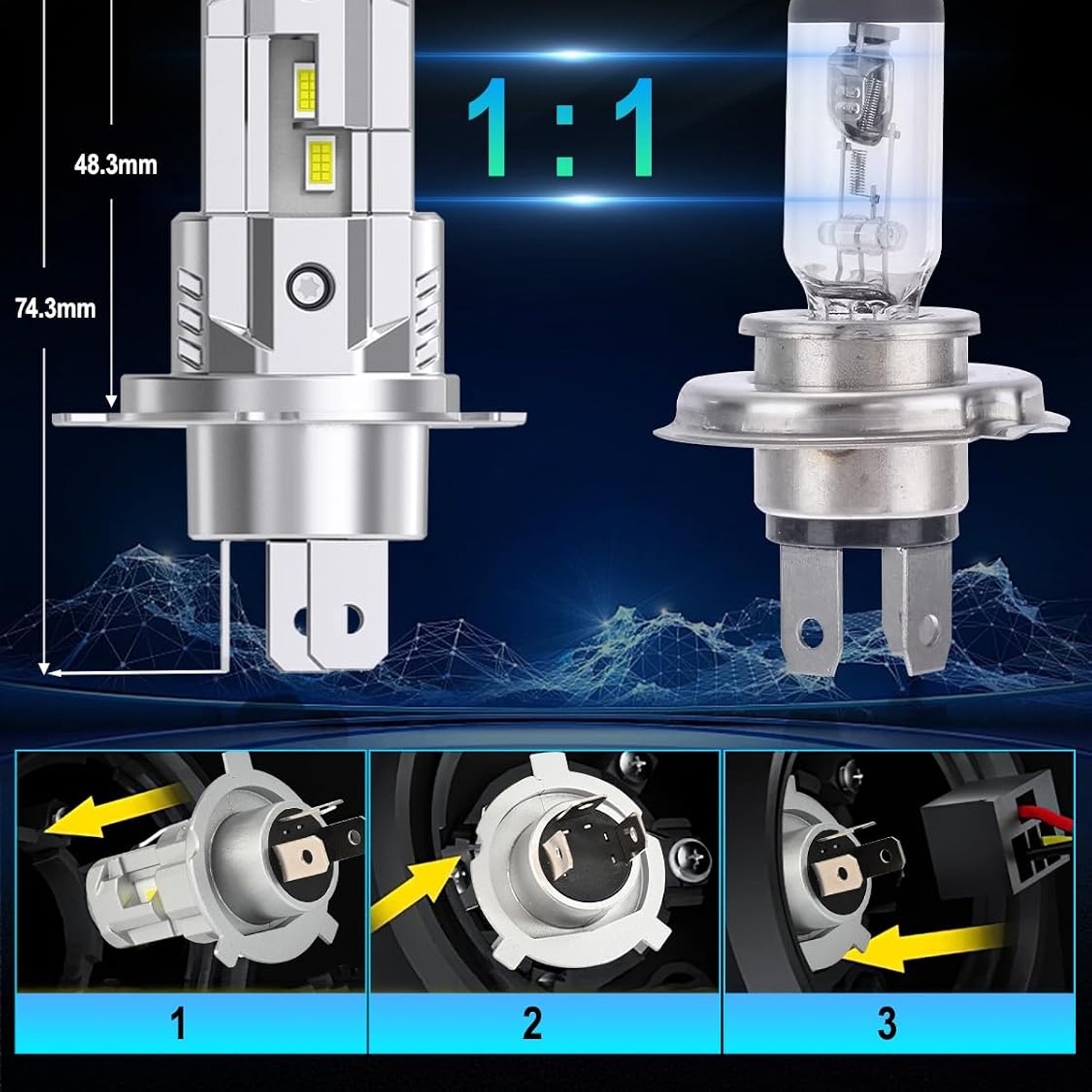
You will also see the same fitting written as 9003 or HB2. Different regions and different catalogues use different codes for it. They are the same base. If the bulb you pull out of your housing is marked with any of those three, the base on this set matches.
What the code does not tell you is whether the bulb physically clears everything behind the housing. That is a separate question and it matters more with LED bulbs than it did with halogens.
Why fanless matters
A lot of LED conversion bulbs put a small fan in the base to move heat away from the chips. It works, but it adds a moving part, and moving parts make noise and eventually wear out. If you have ever sat in a quiet car and heard a faint whirr from the front, that is usually a headlight fan.
This set is fanless. Heat is handled passively through a heat sink instead. No fan, no fan noise, nothing spinning in there to fail. That is the main appeal for people hunting the best fanless led headlight bulbs for a quiet build.
The trade-off is physical. A passive heat sink needs surface area, and surface area needs room. So the one thing you absolutely should check before ordering is how much depth you have behind the headlight. Measure from the back of the housing to whatever is behind it, whether that is a battery, an airbox, a wheel arch liner or the inside of a bike shell. Also look at the opening in the dust cap, because some caps are tight around the bulb base.
Colour temperature, in plain terms
Kelvin numbers describe the tone of light, not the amount. Lower numbers run warm and yellow. Higher numbers run cool and blue-white. At 6500K you are at the cool white end.
It is worth knowing what you are choosing. A 6500K tone looks crisp and modern, which is why the best 6500k led bulbs tend to be popular for show builds and anything where the look of the light matters. Some people prefer a warmer tone instead. Neither is wrong, it is a preference, and this set sits firmly in the cool white camp.
The CANbus question
Here is the issue that catches most people out. Lots of modern vehicles monitor the electrical draw of each bulb, so they can warn you when one fails. An LED bulb draws differently from the halogen the system expects. The vehicle sees that difference and may decide a bulb has blown.
What that looks like in practice is a warning light on the dash, or a flicker in the light itself, or occasionally both. It is not a fault with the bulb. It is the vehicle doing what it was programmed to do.
The usual fix is a CANbus decoder, a small inline module that sits between the vehicle wiring and the bulb. A decoder is not included with this set. If your vehicle needs one, it is a separate purchase.
Can you tell in advance? Sometimes. Owners' forums for a specific model are usually the fastest way to find out whether others have hit the same thing. Otherwise most people just fit the bulbs and see what the dash does.
Who this set suits
It makes sense for anyone running an off-road vehicle, a quad, a field or yard machine, a trailer setup, a track or show car, or a workshop project that uses the H4 fitting and a 12 volt supply. If you have a bike with an H4 headlight and it is used off the public road, the specification lines up too, though shallow bike shells make the clearance check extra important.
It does not suit a road-registered car used on public roads with halogen housings. It does not suit a 24 volt system, since these are 12 volt bulbs. And it does not suit anyone who needs a decoder included in the box, because none is supplied.
Fitting and looking after them
On most H4 housings the swap is simple. Pull the dust cap, release the wire retaining clip, lift the old bulb out, drop the new one in, reconnect and refit the cap. The difficult bit is usually reaching the back of the housing at all, not the bulb itself.
Handle the bulb by its base. Avoid pressing on the LED chips or bending the heat sink fins. If you leave fingerprints, a dry lint-free cloth will clear them. Make sure the dust cap goes back on properly, because the IP67 rating covers the bulb itself and the housing still needs to do its own job of keeping weather out.
Change both at once. That is why they come as a pair. One LED next to one halogen gives you two different light tones side by side, which looks odd and defeats the point.
The short version
This is a pair of H4 LED bulbs, 12 volts, 6500K cool white, fanless, and rated IP67 against dust and water. The H4 fitting is also sold as 9003 and HB2, so any of those codes on your existing bulb means the base matches.
They are sold for off-road, show and private property use. In Ireland, fitting LED bulbs into headlights designed for halogen bulbs is generally not permitted on public roads, and we are not going to pretend otherwise.
Two things to check before you order. First, the depth behind your headlight, because a fanless bulb needs room for its heat sink. Second, whether your vehicle is likely to throw a bulb warning or flicker, in which case you will also need a CANbus decoder, which is not in the box. Sort those two out and the rest is a ten minute job.